Free healthcare cannot continue
So says a Bourgeois minister in admitting that Andrew Lansley'south NHS reorganisation was the 'biggest corrigendum of the Coalition government.' I never thought I would admit it, but I recall he is right. The Health Service is facing massive, and apparently intractable, problems, and many believe that the 'reforms' just made them all worse. Unsurprisingly, this view is prevalent within the medical profession:
Marker Porter, chairman of the British Medical Clan's governing council, said: "Rather than listening to the concerns of patients, the public and frontline staff who vigorously opposed the top-down reorganisation, politicians shamefully chose to stick their head in the sand and plough on regardless.
"The damage done to the NHS has been profound and intense, and then this road to Damascus moment is too lilliputian too late and volition be of no comfort to patients whose intendance has suffered."
Merely, perhaps more surprisingly, this view is as well establish within the Regime itself:
I insider said the plans, which were fatigued up past Mr Lansley, were "unintelligible gobbledygook" and an ally of Chancellor George Osborne said: "George kicks himself for not having spotted it and stopped information technology. He had the opportunity then and he didn't accept information technology."
A former No 10 adviser also told The Times: "No 1 apart from Lansley had a clue what he was really embarking on, certainly not the Prime Minister. He [Lansley] kept maxim his grand plans had the backing of the medical establishment and we trusted him. In retrospect it was a mistake."
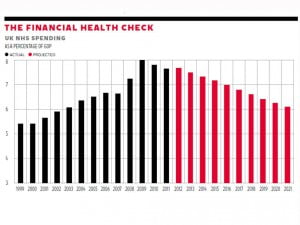 Despite this widespread stance, the current Wellness Secretarial assistant, Jeremy Hunt, even so defends the changes, and says they will deliver savings. In the discussion on Radio 4 yesterday morning, an external health analyst described the Government's figures as being made up to get the answer that they were looking for, and just non reliable. You can see this when comparing past and future costs. Whereas past costs have risen relentlessly, somehow or other hereafter costs are expected miraculously to fall.
The most controversial office of the fiscal equation is the extension of PFI, the private finance initiative introduced past the Conservatives under John Major in 1992, but significantly expanded by Labour nether Tony Blair. It is either the mechanism which is saving money, or a hidden fiscal drain on the NHS, depending on how yous view it. In an open letter to politicians, Richard Laing, the Full general Surgical Registrar, highlights some alarming statistics about PFI.
The NHS volition end up spending 80 billion pounds on hospitals that cost 11 billion to build (I believe one PFI hospital for example, will stop upwards paying iv billion pounds for their 380 million pound building). Most trusts that reside in a PFI building end up spending over 6% of their almanac budget on PFI repayments and this tin can include extortionate maintenance costs.
The largest single player in the UK PFI marketplace currently owns or co-owns xix United kingdom hospitals (and remarkably it only has 25 employees in stark dissimilarity to the one.7 million employed by the NHS). Their profit margin was 53 per cent in 2010 (apparently most successful FTSE 100 companies brand margins of around 6 per cent). The founder and master executive of this visitor, in 2010, endemic almost iii-quarters of the company (or 14 Britain hospitals) and collected pay and dividends of £8.6 million, a meaning proportion of which is substantially revenue enhancement-payers' money (I suppose that'due south non very much when you consider it would only pay for the treatment of diabetes for just over v and a half hours, just nonetheless, it's all relative).
One affair is non in dispute; every bit a result of the reforms, the astute intendance trusts inside nigh of the healthcare regions are massively in debt, and there is a serious adventure that organisations volition start to fail.
It seems to me that there are three moral bug hidden amid all these figures, ane of which is rarely mentioned, and the other ii never feature at all in the debate.
The start is the question of goodwill and the morale of health service employees. Laing points out that, contrary to most impressions, the NHS is remarkably efficient, in that it delivers a very good service at a much lower toll than comparable developed health intendance systems.
Wellness expenditure in the U.k. was nine% of Gross domestic product (USA 17%, Netherlands 12%, France 12%, Germany, Denmark and Canada xi%).
The U.k. had 2.8 physicians per g population (iv.0 in Germany, 3.ix in Italian republic, three.8 in Spain, 3.3 in France, 3.3 in Australia).
The Uk had ii.8 hospital beds per 1000 population (8.3 in Germany, 6.3 in France, 3.4 in Italian republic, iii.0 in Espana).
Average length of stay in the UK was seven days (9.2 in Germany, viii.2 in New Zealand, 7.7 in Italy, 7.4 in Canada).
In comparison with the healthcare systems of ten other countries (USA, Canada, Australia, France, Germany, Netherlands, New Zealand, Norway, Sweden, and Switzerland) this year the NHS was establish to be the most impressive overall by the Commonwealth Fund. It was rated as the best healthcare system in terms of efficiency, constructive care, safe care, coordinated care, patient-centered care and toll-related bug.
And how does Laing account for this remarkable delivery? 'It is considering of the remarkable individuals who work for the NHS.' All the more strange so that Lansley'southward reforms were not based on the experience of those actually working in the system.
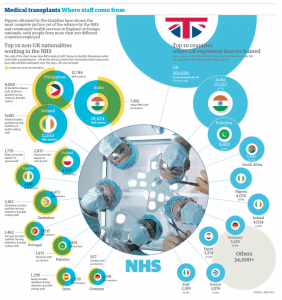 The 2d effect is the NHS's employ of foreign medical expertise. Without cartoon people to the Great britain to piece of work in the healthcare system, the whole organisation would accept collapsed long ago. Overall, 11% of NHS and community intendance employees were strange nationals. But the figures climb steeply the more qualified you get. 14% of professionally qualified clinical staff are not British—and a staggering 26% of doctors. Nearly 10% of doctors come from a unmarried land, India—and you practice not need to think hard to work out which country (India or the United kingdom of great britain and northern ireland) needs qualified doctors the almost.
This data rarely features in debates well-nigh immigration—but at that place is a further question to inquire. How is it moral to suck this kind of professional person expertise from other countries, simply considering, for year upon year upon yr, nosotros have failed to train plenty doctors and other trained staff for our ain needs? This twelvemonth the Midlands region has only been able to fill 63% of its training places for doctors.
The 3rd moral question touches on the founding principle, and perhaps the almost distinctive feature, of the NHS. 'Free at the point of commitment' is the untouchable mantra of all political comments nigh the health service. Woe betide any politician who suggests that this should change. But what is often forgotten is that this commitment was predicated on iii assumptions about wellness and healthcare:
ane. With the institution of a free, national service, overall levels of wellness would improve.
2. The delivery of healthcare, after an initial step-change up, would non continue to go more than expensive.
3. People would accept more and more than responsibility for their ain health, so that in the long term, demand for care would fall.
In ane sense, the first has come truthful, in that the overall health of the nation has improved drastically, with life expectancy standing to rising. Merely the problem is that something similar 80% of NHS costs relate to the last 10 years of life, and extending old age is just going to push costs upwards. The second is conspicuously false; one of the dilemmas in Western medicine is the availability of ever-more expensive forms of treatment, every bit shown by the controversy when cancer treatments are judged to exist as well expensive to brand available through a 'gratuitous at signal of use' system.
 Only the most challenging is the third. The 2 biggest strains on the NHS are obesity and alcohol misuse—entirely preventable bug under the control of patients. It is claimed today that 10 million hospital visits a year are due to alcohol misuse, leading to both acute and chronic illness. And obesity is increasing at alarming rates which volition push up health costs and the demand on services. The moral dilemma comes from both sides. On the one hand, why should I proactively accept care of my health when whatever problems that arise will be dealt with at no cost to myself? On the other, why should I keep to contribute to the healthcare of people who do non take responsibility for themselves when I practice for myself?
The upshot here is a mismatch between a socialist, communitarian model of behaviour assumed in the 'complimentary at point of delivery' delivery, and an individualist, gratuitous-market place model of behaviour in the language of customers and service. The ii cannot co-exist in a sustainable health service.
And yet this conflict is built into the bones processes of the NHS. The capitation system, where GPs are paid per patient regardless of how many times they visit, is based on the supposition that patients take responsibleness for their own health. It creates incentives for doctors to encourage patients to practice this—but it completely contradicts the idea that patients are 'customers' expecting to get a 'service', an idea fabricated explicit past John Major with the 'Patient's Charter.' Imagine customers in any other service context demanding a certain level of service when they have paid a fixed fee to go unlimited admission to the production whenever they demand it. The system has created large disparities between wealthy areas, where patients visit less, and poorer areas with much higher levels of patient attendance. In the erstwhile, practices can take on more patients; the doctors there earn more than; so jobs are easy to make full as in that location are many applicants per vacancy. In the latter, work is more demanding, doctors earn less, and practices discover it difficult to recruit.
Given these underlying bug, any political political party trying to brand the NHS work within budgetary constraints is attempting to square a circle. Even Lansley's reforms are using private money to rearrange the deck chairs—though of course we might now savour a better quality of deck chair. We either need to abandon the individualist, market-led consumer model of patient behaviour—or start charging for the service at its point of use. There is no middle way.
Much of my work is washed on a freelance ground. If yous have valued this post, would you considerdonating £1.20 a month to support the product of this blog?
If you enjoyed this, do share it on social media (Facebook or Twitter) using the buttons on the left. Follow me on Twitter @psephizo. Similar my page on Facebook.
Much of my work is done on a freelance footing. If you accept valued this post, you lot can make a single or echo donation through PayPal:
Comments policy: Proficient comments that appoint with the content of the post, and share in respectful contend, tin add together real value. Seek first to sympathize, then to exist understood. Make the well-nigh charitable construal of the views of others and seek to learn from their perspectives. Don't view debate as a conflict to win; address the argument rather than tackling the person.
Source: https://www.psephizo.com/life-ministry/free-healthcare-cannot-continue/

Post a Comment for "Free healthcare cannot continue"